Still Outraged at 100: Muriel Rukeyser’s Centennial

Muriel Rukeyser has been dead for 33 years, but we just can’t keep away from her. On the occasion of her recent centennial, Chanel Dubofsky and I gave her a nickname and talked about the ways this incredible lady built essential bridges between art, activism, and work. 

Courtesy of the Paris Review.

Leah Falk: 

So–I guess I would like to start by asking you how you first came to/ heard about Muriel Rukeyser, or if we can give her a posthumous nickname, “The Ruk.”

Chanel Dubofsky: 

So I think I heard about, um, The Ruk in college. I was in this weird band of poetry people.

LF: The best band.

CD:  YES. Even though I’m not actually a poet, we needed each other. Anyway. Someone brought The Ruk to a gathering, and she immediately felt important to me.

Continue reading

I Left Nothing Behind: An Interview with Kerry James Evans

Image

Your first career was as a combat engineer for the National Guard. Can you describe your path toward poetry and deciding to get an MFA?

When I started out in college I was—like many young students—thrust into the world, autonomous for the first time, and without any idea how to manage it. I wasn’t performing particularly well in school, and, mostly, I felt without direction. During my sophomore year of college I was deployed to Fort Leonard Wood in Missouri to guard a gate for a year. I got up at 3 each morning, went to the armory, and then guarded the gate from 5am-1pm. After, I did physical training for two hours then attended night classes at the local university. I made up sleep on the weekends, when I wasn’t studying. I knew after, when I returned to Missouri State, that I wanted to write poetry seriously, and to do that I had a great deal to learn. I still do.

When you started the degree, what were you leaving behind?

I worked as an editor for a certain program within the Department of Justice. Before that I worked for two and a half years as an investigator for a law firm in Springfield, Mo. I also picked up part-time work in the university library—a job I secured only for the chance to read literary journals (they could not be checked out). In high school I worked at Little Caesar’s for almost three years while running both cross-country and track. In middle school and early high school—before I had a car—I hauled hay in Mississippi and landscaped for local businesses.

I left nothing behind. I have always enjoyed work, and when I started the MFA program the job may have changed, but my work ethic did not.

Your first book, Bangalore, deals quite a bit with your experience in the military. How do you think being part of academia (as an MFA and Ph.D. student and now as an adjunct instructor) has changed your recent writing—the process of it, its content, or both?

I’ll just say this: as I evolve, my poems evolve.

How long did you spend looking for work after the MFA?

I applied for Ph.D. programs during the third year of my MFA program. I was fortunate enough to be accepted to Florida State’s Ph.D. program, which offers a teaching assistantship and the opportunity to teach a variety of classes in addition to studying with excellent writers and scholars.

Do you envision staying in academe? What do you like about it, and what gives you pause?

I do. I like learning, and teaching is a great way to learn. I want my poems to continue to evolve, and teaching allows me to be around talented writers with new ideas and different experiences. I have learned as much if not more from my students and peers, as I have through my own research, which is invaluable to me as a poet.

Do you ever have any regrets about getting an MFA?

I have no regrets about earning an MFA. I had the opportunity to work with great poets who I respect and admire—both professors and colleagues. It is an experience that continues to inform how I approach poetry.

Do you think that more MFA programs should draw students’ attention to other career paths than university teaching? How could this be accomplished?

I think a great deal of programs provide alternative career paths to students. The MFA program I attended did a great job of exposing students to a variety of experiences, whether working for the literary journal or serving as an intern for the university press. We also created a visiting writers’ series as well as a writers’ festival, which taught us a lot of valuable skills about things outside teaching, i.e. fundraising, networking, and time management. The faculty hosted a professionalism seminar each year where they answered our questions and told us about the job search process. The same kinds of opportunities were presented in the Ph.D. program I attended.

Do you have any other words of advice for writers entering MFA programs from the workforce?

I think it’s good to set specific, manageable goals. I know many people who have published books while still in the MFA program, and that’s impressive, but I would say that is an exception to the rule. Publishing is important, but learning one’s craft is more valuable. I think the more focus that students put toward honing individual skills, the better chance their poems can be heard.

Kerry James Evans is the author of Bangalore (Copper Canyon). He holds a Ph.D in English from Florida State University and an MFA in Creative Writing from Southern Illinois University-Carbondale. He lives in Tallahassee, Florida.

Time Carved and Stolen: Curtis Smith on Writing and Work

IMG_0760 

For the past thirty-one years, I’ve worked with special learning students in a public high school in Pennsylvania. My day job precedes my first short story by six years and my MFA by over a dozen. My job has its rewards—and its frustrations and heartbreaks. Still, I don’t mind getting up every day and going to work, and in the end, I understand I can’t ask for much more. Writing has been the complement to my work, a place all my own, time carved and stolen from each day’s beginning and end, bookends of quiet and reflection in an otherwise hectic ride. Writing has given me the gift of engagement and creation—and sometimes, of sanity.

My late twenties found me in a good place. I’d landed my teaching job a month before my graduation, and after six years, I felt established, no longer the new guy. I was in love and recently married. Yet part of me was restless. Many of my friends were artists and musicians, and I yearned to be creative. I’d made a few 8mm films, and I’d refinished some old furniture procured from basements and auctions. I’d enjoyed these ventures, their hands-on processes, their tangible results. Yet I wanted something more. Or something different.

So I started writing. I had no English background; in fact, I’d always been more of a science-and-math person. In college, I’d struggled with my comp and lit classes. Why, I wondered, did Madame Bovary’s bouquet have to be anything more than a bunch of flowers? Part of my attraction to writing was due to stubbornness, one of my less admirable traits. Not being good—or at least passable—at something bothers me. Vain, I know, but I accept it as part of my makeup—and sometimes, the results of this shortcoming have left me a better person. Finishing in the stragglers’ pack of a seventh-grade race has led me to be a life-long runner. Madame Bovary’s wilted flowers goaded me to a second career of trying to explain my heart with pen and paper.

So I wrote. Every day, every evening. I read voraciously. I began submitting, and within a few years, I started to publish, not much but enough to earn my entry into Vermont College’s low-residency MFA program. I was fortunate—in Pennsylvania, school teachers needed at least 24 graduate credits to attain their permanent certification, and many districts, including mine, offered tuition reimbursements. Vermont was my first choice—I was already familiar with the work of a few of their teachers. I couldn’t attend the winter residencies, so it took me twice as long as most to graduate, but this turned into a blessing that allowed me to stretch my legs, to digest what I’d learned and use it to develop new material.

In the past few years, I’ve been invited to talk to students at different MFA programs. I tell them that my MFA studies were a valuable part of my maturation as an artist. I learned and read things I wouldn’t have discovered on my own. I developed friendships and connections I still cherish almost twenty years later. Most importantly, I came to understand that the people I met, all smart and motivated and creative, were also my competitors—and if I my work was going to find a place in the tight market of lit journals and small presses, then I needed to hold my writing to a higher standard. This scrutiny has become the most integral part of my writing routine, the continual asking if this story, this paragraph, this sentence is the best I can do.

Next year I’ll retire. I’ve had a good run with my crew, 33 years, and I’ve no doubt learned as much from them as they have from me. I’m already testing the waters of my next phase—I’ve been fortunate to have landed a number of visiting writer gigs at local colleges, and I’ve started some adjunct work, my MFA finally of use in an official manner to justify my employment. I don’t know what awaits—but I’m curious. And curious, I believe, is good.

Curtis Smith’s most recent books are Beasts and Men (stories, Press 53) and Witness (essays, Sunnyoutside). His next book will be a novel, Lovepain, from Aqueous Books

What a Difference a Day [Job] Makes: Some Notes and Reflections

Image

Cary Grant, ladies and gentlemen.

It’s been a little quiet around here lately. There’s a good reason for that, and no, it’s not because I poisoned some old gentlemen and hid them in the windowseat. Lo and behold,after a few months of asking people about their day jobs, I have one too.

Going forward, I’ll keep most of the details of my work life, like who I work for, names and projects, private. But I’d like to take a moment to think about how, in just a month of working a job—and yep, outside academe—my ideals and daily practices have changed.

1. Part-time is a state of mind.

My job, for the time being, is only two days a week. My twenty-two year-old self might have resented a less than full-time gig and clocked in and out accordingly. But I like this job, and eventually I’d like it to be possible for someone to consider hiring me full-time, or even just for more weekly hours. So the time and energy I put in tend to expand—as they do when I sit down to play with a manuscript, or as they did when I dreamed up lesson plans. I have to hold little tribunals with myself about how often it’s okay to check work email on my days off. But I’m certainly not all virtue. The tribunals (made up of my regular self, a version of me with sunglasses and no pants, and a medieval rabbi version of me—what would Freud say) extend to whether it’s really okay to wait until Tuesday to start thinking about that urgent thing that’s due the week after. Does this eat into my writing time? Maybe. Does it also make me feel pretty useful and stave off depression? Probably.

2. Good ideas and smart people are everywhere.

I’ve been lucky enough in my life to have experienced several situations where I felt almost spoiled by the talent, goodness, and passion of the people around me. I felt this way as a high school student spending a summer at the Pennsylvania Governor’s School for the Arts (now on long hiatus), a number of times in college, and in graduate school. In these situations, brilliantly engineered by admissions counselors and teachers, people spontaneously created theater projects together, had three-hour dinner conversations with folks they had met that afternoon, and traded work they’d never shown to anyone else.

I don’t think it’s an accident that I got to experience this kind of atmosphere multiple times—in fact, I know that I sought to reproduce it in my life again and again. So why should I—why should anyone—expect that just because they’ve left “the bubble” of a great MFA program or community of writers, they can’t find another place where people care about ideas, good conversation, and working on projects whose outcomes they wholly support? My workplace now, I’m happy to say, is full of people who would happily interrupt their data-entry to discuss the work of a 20th century Lithuanian poet, and who listen carefully when someone else has an idea. There’s some luck involved in finding that kind of place, I admit; but it can also be something you actively seek out or even carry around with you.

3.  Dust and ashes.

Let me get a little existential here. Like many people I’ve interviewed on this site, I do a lot of writing, editing, and submitting when I can. Nothing much about the way I do that has changed, except that there’s a sense of both urgency and ordinariness to it now—I don’t feel lifted up, promised, the way I did as an MFA student and post-MFA fellow. Writing is something I wake up and do, like going for a run or making coffee or getting on the train to go to work. But where as a student—and even as a younger person with other day jobs—I felt like I had all the time in the world, I usually feel that writing must be done now. There might not be time later, and later my head might be full of something else. I move through the usual good and bad writing feelings (usually: somebody likes me/ nobody likes me/ I am created in the image of the Lord/ I am but dust and ashes), and I try to recognize that whole range of feelings as a possible daily range. Anger is not just for special occasions, and neither is pride.

*

As I continue to “live” this blog–as an MFA with a day job–on a daily basis, I’d also like to hear from you guys: have you taken a job (or two or three) recently, and have you witnessed a shift in your priorities or practices? Positive, negative, or in between, write about it and send it this way, sil vous plait.


Ph.D. Day Job–Part the Second

“Dr. Rogers suggests that alt-ac is less a matter of where you work than how — ‘with the same intellectual curiosity that fueled the desire to go to graduate school in the first place, and applying the same kinds of skills, such as close reading, historical inquiry or written argumentation, to the tasks at hand.’”

Over at The New York Timeswe get a reminder–did we need one?–that higher ed of all kinds is a means, not an end. All for starting an alt-ac MFA support group on the eastern seaboard, say aye (you’re welcome to do your party-planning in the comments). 


In Thirty Seconds Or Less: An Interview with Hieu Huynh

Hieu profile pic

Hieu Huynh is a writer/producer with CNN’s On-Air promotion department based in Atlanta, GA. She is enrolled in NYU’s inaugural low-residency MFA program with workshops in Paris. When she’s not writing poetry, she’s eating her way around the world.

You’re currently a writer-producer at CNN. Tell me a little bit about what that work is like on a daily basis. 

Every day is different and that is exactly what I love about working at CNN. I love knowing that what I do makes an impact and that my work can be seen all over the world. Today, I may be writing about the aftermath of the government shutdown; the next day, I could be writing about a national tragedy…all in thirty seconds or less.

Continue reading

Selling Your Secret Life: MFA Lessons for the Entry-Level Job Search

Today, something a little different. Wendy Fox, who holds an MFA from the Inland Northwest Center for Writers and by day works as the marketing director for a technology company, offers some job-searching advice with MFA-colored glasses. 

*

Going out on the job market fresh from an MFA can be daunting. It’s hard enough for new grads with degrees that lead more obviously to gainful employment, like business or accounting. Yet creative writers are marketable and skills like knowing how to meet deadlines and communicate effectively are both useful and in demand in a variety of professional settings). Continue reading

A Day Job More Distant: An Interview with Paul Kerschen

kerschen

Why did you decide to pursue an MFA?

All sorts of reasons, the worst of which was thinking that the credential in itself would lead straight to literary success. The day my acceptance letter came from Iowa, I went bouncing around my dorm room with the Pixies blasting; I thought I was made as a writer. It didn’t occur to me that I hadn’t written anything yet.

Continue reading

Enormous Changes at the Last Minute

Ann Arbor, August. I am packing my “relo-cube” with the contents of my one-bedroom apartment. Proust had madeleines, I have a scratched dining table my father owned in his grad school days; boxes of poetry books signed by their authors; end-tables my mother painted and decoupaged with pressed flowers; a red Schwinn road bike gifted to me by a friend; photos of my mother and father and grandmother, each at twenty; a print of Klee’s “Angelus Novus” my brother bought for me in Jerusalem; and, toward the end, lone shampoo bottles and boxes with labels like “printer/ pizza peel/ scraps of fabric.”

Despite a year-old agreement with my partner that we’d move together “wherever I got a job,” I am done with my M.F.A. and jobless and moving to live with him in Brooklyn, where I never wished to move. “Leah Falk lives in Brooklyn” is a sentence I did not want ever to have to put in a contributor’s bio – it felt like a cliché, a naïvely conceived dreamscape for hundreds of artists who didn’t realize that New York had become too recognizable, too expensive for them to live out their dreams. But as a fiction writer friend reminded me before she made the same Michigan-Brooklyn move a year earlier (in the words of The Goon Show’s Spike Milligan): “Everybody’s got to be somewhere!”
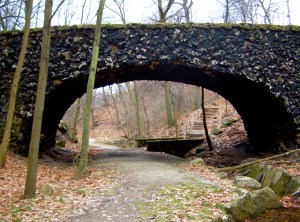
SchenleyPark_Bridge_Pittsburgh

Two roads diverged in a yellow wood? Autumn in Schenley Park, Pittsburgh.

And so I am stuffing toiletries into bags that once contained sheet sets. I am renting Zipcars to take paper bags of dishes to Goodwill. I am eating tuna sandwiches from the deli down the block standing up at my kitchen counter. I am taking walk after walk to say goodbye to Ann Arbor’s bulk food stores, its running trails along the Huron River, its chicken coops, its starry night sky. Days before the cube is due to be picked up, I receive an email from the English department at my university. They offer me the opportunity to teach three courses in the coming semester—a semester that begins in two weeks.

As in many humanities departments across the country, in ours graduate students teach an average of a course per semester while they complete their degrees. When we finish, many of us apply to work as adjunct instructors, or lecturers. Michigan treats its non-tenure-track faculty better than many places I can think of: despite anti-union sentiment in Lansing, the state’s capital, both graduate student instructors and lecturers are unionized; they receive excellent health benefits, help with childcare, and most enjoy a strong sense of community within their departments. Historically, many finishing M.F.A. students there have applied for, and gotten, work as lecturers after their degrees for at least a semester.

This past year, due to a quagmire of right-to-work legislation and games of chicken between the state government and its flagship university, a hiring freeze was in effect when most brand-new hires might have expected an offer letter in their mailboxes, back in May or June. Most of us did what any job candidate is advised to do when his prospects look less than hopeful with an employer: we moved on. In August, I didn’t know what I was moving on to, but I had, weeks earlier, decided not to wait around for the email that popped into my inbox just as I slid the lock closed on my moving cube.

Nevertheless, it took me two days to write an email declining the offer. Why? I had already begun this blog, and had had countless conversations with other writers whose view I shared that adjunct work was not the means to the life we wanted: creative, professional, economic, or otherwise. But I couldn’t shake the feeling, as I pressed “send,” that I was leaving something important behind, making, in the words of G.O.B. Bluth, “a huge mistake.” Lately, I’ve been considering where exactly that feeling comes from.

In two important stages of my life, childhood and college, my models of working people were all professors. All of them. My father was a professor, and his best friends were, too. They taught subjects ranging from chemistry to law to history to engineering, but dinner party conversations clustered around higher education, student performance, and administrative issues. These were men and women whose daily habit was knowledge for its own sake – even those whose academic research often had direct bearing on the private sector.

Besides being my parents’ friends, these people were in effect my second extended family: we were at their Passover and Thanksgiving tables, they babysat us, we attended each other’s families’ weddings, bar mitzvahs, and funerals. On Saturdays, my father and his friends, sometimes accompanied by my brother and me, followed a run in the city parks with coffee and bagels, as they had for almost thirty years.

I didn’t follow any of these people into their fields, but in a sense I did follow them into higher education: I wanted to reproduce a working atmosphere where being surrounded by challenging ideas was normal, where creating new knowledge was the source of workplace collaboration and celebration. And I followed my teachers, too – the next adults with whom I had thought-provoking conversations about learning and writing and art were my college professors.

But many of these adults worked in fields where, if they hadn’t worked in academia, they could have turned to industry. Others, like my English professors in college, entered the academy at a time when adjuncts didn’t make up nearly two-thirds of the workforce. If they taught in creative writing programs, they had often earned Ph.D.’s in English, before the M.F.A. became first the standard terminal degree in the field and then, like a wartime currency, slowly dwindled in value.

So when I declined my university’s offer, as I had to, because there was a cube full of my stuff and a person I loved and a city I hadn’t ever meant to live in awaiting me, I wasn’t just declining a one-semester position (although it was possible that was all it would be) and the opportunity to teach a course I had designed. I was acknowledging that in order to find the things I cared about – people who valued ideas, people who wanted to continue learning their whole lives, work that used my skills in the service of values I held dear – I might have to look elsewhere. That universities – institutions that surrounded me as a child, that helped build my conversations, my education, and my family – might, for my generation, might not be the only place, or even the best place, to look for those things.

(I stole the title of this post from Grace Paley.)